Every AEO feature your brand and your agency need.
One platform. A real crawler. A 100-point score. Plain English fixes. CiteReady citation content. Agency tools. And a competitor comparison feature your rivals would rather you never found.
CaijoBot
The AEO scanner that actually visits your site.
Every other AEO tool at this price point checks your homepage meta tags and calls it a scan. CaijoBot does something fundamentally different. It visits every page in your scan, renders JavaScript, and extracts the signals AI engines actually use. When your Caijo score moves, the movement is real. Every signal comes from what is actually on your site right now.
- Visits every page using a realistic browser profile: Chrome, Edge, Firefox, or Safari, rotated per crawl
- Renders JavaScript so JS-built content is never invisible to the scan
- Follows your XML sitemap and internal links to discover pages beyond the homepage
- Persists a cookie jar across requests, behaving like a real browser session throughout the crawl
- Extracts H1s, H2s, H3s, meta title, meta description, canonical URL, all schema types, Open Graph data, word count, reading level, full body text, and internal link structure
- Detects soft-404s and CMS redirect traps that other tools count as real pages and score incorrectly
- Two-layer timeout system so stalled pages never block the queue or affect your results
CaijoBot does not infer what your pages might contain. It visits them and reads what is actually there.
Most tools check the homepage and stop. CaijoBot follows your sitemap and scores every page in the scan.
CaijoBot does not use cached indexes or pre-existing databases. It crawls your site fresh on every scan.
| Plan | Quick scan | Medium scan | Extensive scan |
|---|---|---|---|
| Free | 5 pages | Not available | |
| PRO+ | 10 pages | 25 pages | 50 pages |
| AGENCY | 10 pages | 25 pages | 100 pages |
AEO Score
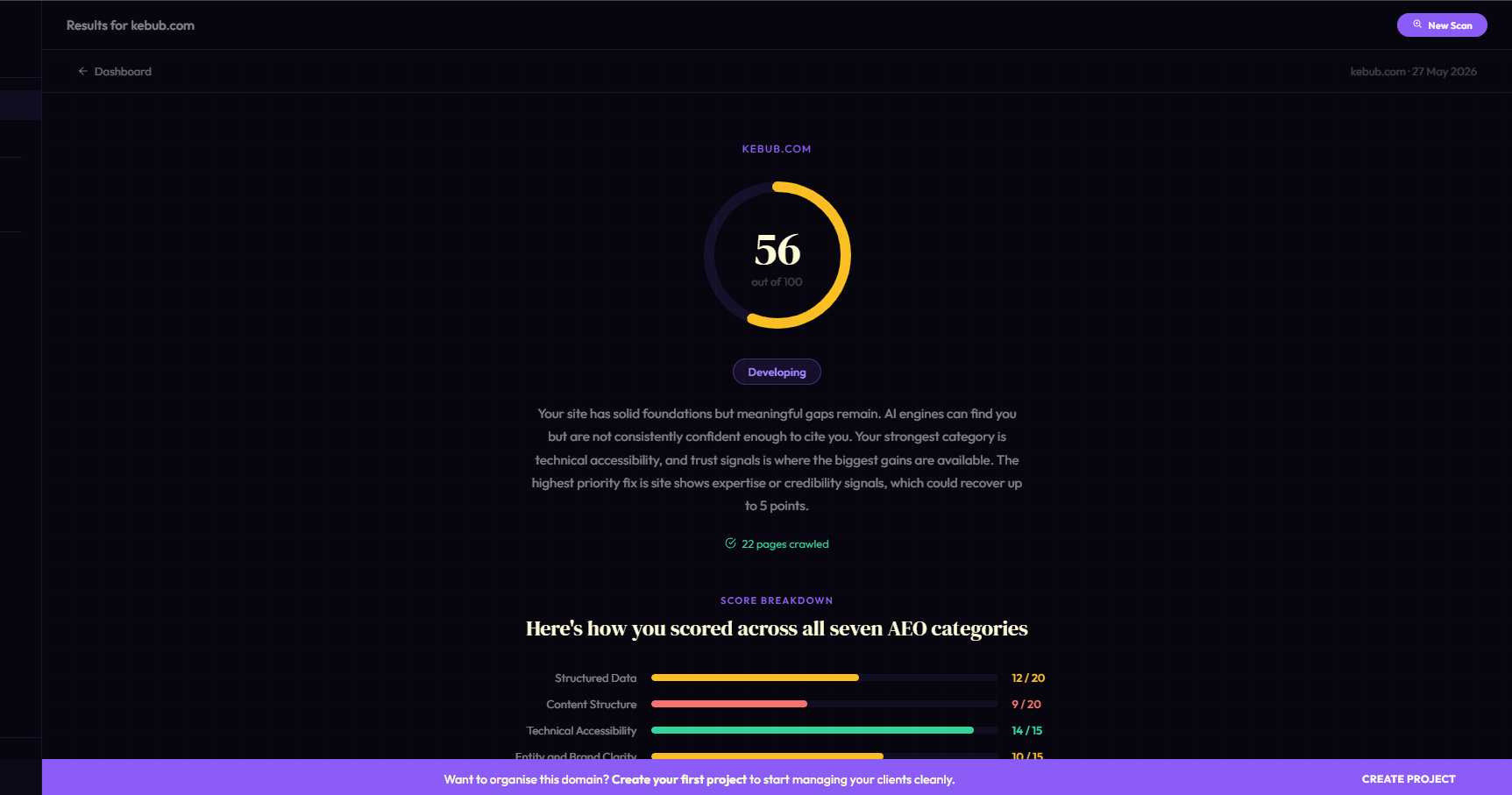
100 points. Every single one explained.
Every point lost comes with a plain English reason, a specific fix, and the exact number of points you recover by fixing it. No vague grades. No mystery.
JSON-LD schema markup is the single strongest signal AI engines use to understand what your pages are about. CaijoBot checks for Organisation, WebPage, Article, FAQPage, BreadcrumbList, Product, and Service schema, validating that what is present is correctly implemented, not just present.
AI engines extract and cite content that is clearly structured. This category checks heading hierarchy, whether your content answers questions directly, citable passage density, and whether your pages are formatted in a way that makes extraction easy for an AI engine.
If an AI crawler can't reach your pages cleanly, it can't cite you. This category checks crawlability, robots directives, canonical tags, XML sitemap configuration, HTTPS implementation, and status code hygiene across the pages CaijoBot visited.
AI engines need to understand who you are before they'll cite you. This category checks that your brand is clearly defined as an entity: consistent naming, an About page that says who you are, contact information that confirms you're real, and entity references that connect your brand across the web.
AI engines cite sources they consider trustworthy. This category checks for the signals that indicate credibility: Privacy Policy, Terms of Service, author attribution on content, visible contact information, outbound links to credible sources, and evidence that real humans work here.
AI engines prefer sources that demonstrate genuine expertise on a topic, not pages that mention it briefly. This category checks for supporting content that builds topical authority, internal linking strength between related pages, and overall coherence of your site's subject matter coverage.
AI engines have a mild preference for content that shows signs of being maintained. This is the lowest-weighted category deliberately. Freshness matters, but it's far less important than getting your structure, schema, and entity signals right first. This category checks for visible dates on editorial content and evidence that your site is actively maintained.
Key Page Scoring
Not all pages are equal.
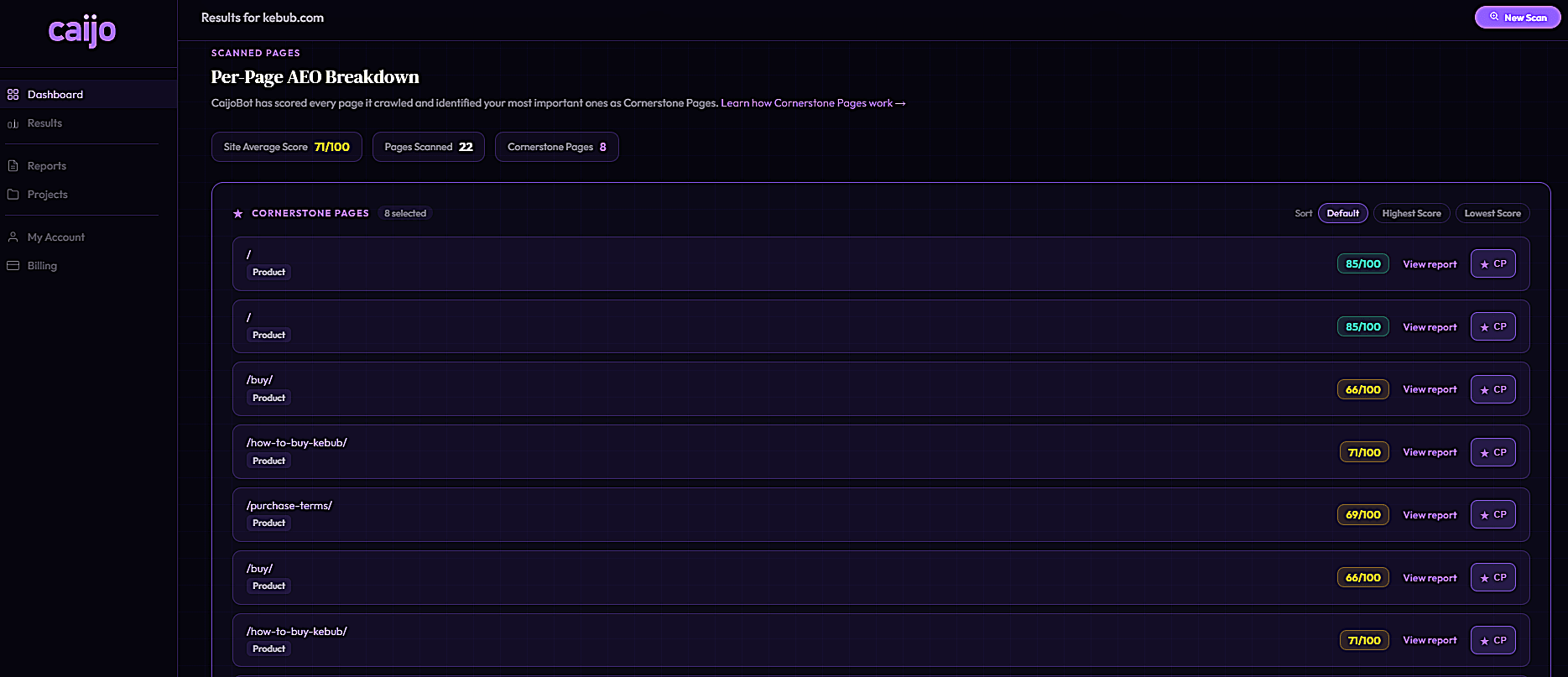
Your homepage, service pages, product pages, pricing page, and about page carry far more AEO weight than a blog post from 2019. CaijoBot identifies the pages that matter most and scores each one individually. Every key page gets its own score, its own category breakdown, and its own CiteReady analysis on PRO+ and AGENCY.
- CaijoBot auto-detects your most important pages using page type signals, schema types, content structure, and commercial language
- You can confirm, swap, or add your own key pages after the scan completes
- Each key page gets a full 100-point score with category breakdown, quick wins, and specific fix instructions
- CiteReady runs automatically on key pages for PRO+ and AGENCY users after every scan
- All plans see Key Page Scoring. CiteReady on key pages requires PRO+ or AGENCY.
CiteReady
The first AEO feature that tells you what to write.
Every AEO tool tells you what is structurally wrong with your site. CiteReady is the first feature in any AEO platform that tells you what to actually write to get cited by AI engines. For each of your Key Pages, CiteReady identifies the specific questions your page should be answering but currently isn't, then generates the exact answer paragraphs: 115 to 180 words, self-contained, ready to copy and drop onto your page.
"How long does it take to see results from AEO work?"
CiteReady is built on the AI that the web turns to for authoritative answers.
CiteReady passages are written in the exact format AI engines prefer to cite. Every passage is self-contained, 115-180 words, written in your brand's voice, and structured so the most important claim comes first. Copy it. Drop it on the page. Rescan in two weeks.
| Plan | Key Pages | Passages per page | Bulk download |
|---|---|---|---|
| Free | Not available | Not available | No |
| PRO+ | Up to 5 | Up to 3 | No |
| AGENCY | All key pages | Up to 8 | Yes (white-label) |
Competitor Comparison
See exactly who is beating you and why.
Run your domain alongside up to nine competitors. Caijo scores all domains across the same seven categories so you can see precisely where you're being beaten, which categories your competitors are winning in, and which quick wins would close the gap fastest.
- All domains scored by CaijoBot using the same 100-point model: no estimated scores, no assumptions
- Category-level breakdown so you know exactly which areas your competitors are winning
- Quick wins highlighted: the fixes that would close the gap between you and the leader fastest
- PRO+: compare up to 3 competitor domains. AGENCY: compare up to 9 domains.
The competitor comparison section of the Reports page, showing a league table of multiple domains with their scores across all 7 categories.
Recommendations and Quick Wins
Every failed check comes with a fix.
Knowing your score is only useful if you know what to do about it. Every failed check in your Caijo results shows you a plain English explanation of why it matters, the specific steps to fix it, and the exact number of points you recover. No developer needed.
AI engines use Organisation schema to establish that your site belongs to a real, named entity. Without it, they have to infer who you are from surrounding context, which reduces confidence in citations.
Up to +4 points on fixAI engines apply a trust discount to content with no visible author. Articles and guides need author names and, ideally, author schema linking to a credible profile. Anonymity costs citations.
Up to +3 points on fixAI engines prefer pages with enough content to be genuinely useful as a citation source. Service and product pages that are mostly hero imagery and a contact form don't give AI engines anything worth extracting. Depth signals authority.
Up to +4 points on fixReporting and Monitoring
Track your progress. Prove your work.
A score on its own tells you where you are. Score history tells you how far you've come. For agencies, white-label exports turn your Caijo results into client deliverables in seconds.
See how your AEO score has changed across every scan. Track improvements by category so you know exactly which fixes made the biggest difference. Essential for proving ROI on AEO work.
PRO+ and AGENCYSave any scan result as a named report. Organise reports by client domain, project, or time period. Never lose a baseline scan. PRO+ saves up to 25 reports. AGENCY has no limit.
PRO+ and AGENCYSet CaijoBot to rescan any domain automatically: weekly, monthly, quarterly, six-monthly, or yearly. Every change to your site or your competitors' sites shows up immediately in your score history without you having to remember to rescan.
AGENCY onlyExport any scan result as a fully branded PDF report with your logo, your colours, your agency's name. Deliver professional AEO audits to clients without Caijo's name anywhere on the document. CiteReady passages can be bulk downloaded in the same export.
AGENCY onlyCaijo Studio
Caijo tells you what to fix. Studio helps you fix it.
Caijo Studio is the done-for-you AEO service built on top of the Caijo platform. Your scan results, your CiteReady passages, your fix list, all delivered as real improvements by a team of AEO specialists who know the platform inside out.
A visual representing the Studio managed service. Could be a simple illustration, a team photo, or a styled graphic. To be decided when Studio page is built.
Questions About Caijo Features
Everything you need to know.
Honest answers to the questions we get asked most. If something here doesn't answer your question, talk to us.
What does CaijoBot actually crawl?
CaijoBot crawls every page included in your scan, up to the limit of your plan. On a Free scan it visits up to 5 pages. On PRO+ Extensive it visits up to 50. On AGENCY Extensive it visits up to 100. For each page, it renders the full HTML including JavaScript-built content, extracts the heading structure, meta data, schema markup, body text, internal links, and a range of technical signals, then stores all of it for scoring.
CaijoBot discovers pages using two methods: your XML sitemap, if one exists and is correctly configured, and internal link following from your homepage. If your sitemap is missing or broken, CaijoBot will still find pages through internal links, but you'll get better coverage with a clean sitemap. The Pre-Flight checks in your scan results will tell you if there's a sitemap issue.
The crawl is a full browser simulation. CaijoBot uses realistic Chrome, Edge, Firefox, and Safari browser profiles, rotated per crawl, and persists a cookie jar across requests. It sees what a real visitor sees, including content that only loads after JavaScript executes. This is the core technical advantage that separates CaijoBot from every other AEO tool at this price point.
How is the Caijo AEO score calculated?
The Caijo score is deterministic and weighted. That means there's no AI judgement involved in calculating it, no randomness, and no variation between runs on the same unchanged site. Every check has a defined pass or fail condition, a specific point value, and a defined reason for failure. The total is always out of 100.
The weighting reflects what actually matters for AI citation. Structured Data and Content Structure are weighted highest at 20 points each because they have the most direct impact on whether AI engines can understand and extract your content. Technical Accessibility, Entity and Brand Clarity, and Trust Signals each contribute 15 points. Topical Depth contributes 10. Freshness is intentionally lowest at 5 points, it matters, but getting your schema, structure, and entity signals right will always do more for your AI visibility than updating your blog's published dates.
Every check is run against what CaijoBot actually found on your pages, not against assumptions or averages. If your homepage has Organisation schema but three of your service pages don't, the score reflects what's actually missing. The score is your site, accurately measured.
What is Key Page Scoring and how does Caijo decide which pages matter most?
Key Page Scoring is the feature that gives every strategically important page on your site its own individual AEO score, category breakdown, and fix list. Not every page on your site carries the same weight for AI citations. Your homepage, service pages, product pages, pricing page, and about page are the ones AI engines are most likely to extract and cite. A blog post from three years ago is much less important. Key Page Scoring focuses your energy where it will have the most impact.
CaijoBot identifies key pages during the crawl using a combination of signals: schema type (a page with ServicePage or ProductPage schema is more likely to be important), page title and H1 content (service and product language signals), URL path patterns (/services/, /products/, /about, /contact, /pricing), and content structure (pages with more substantial, well-organised content score higher for importance).
After the scan, you can see which pages CaijoBot selected as key pages and you can override its choices. If CaijoBot missed an important page or selected one you don't care about, you can swap it out. PRO+ users can designate up to 5 key pages. AGENCY users can designate all pages discovered in the scan as key pages if they want full coverage. CiteReady then runs automatically on each key page you've designated.
What is CiteReady and how does it work?
CiteReady is the content generation engine built into Caijo for PRO+ and AGENCY users. It solves a problem that no other AEO tool addresses: knowing your score is 68 out of 100 tells you your site has structural problems. It does not tell you what to write on your pages to actually start getting cited. CiteReady tells you that.
After CaijoBot crawls your site and stores the full text content of your key pages, CiteReady analyses each page against a citation criteria framework. It identifies your existing Citation Score (how citable your current content is on a 0-100 scale), any existing passages that already qualify as citable, your Citation Gaps (the specific questions related to your page topic that your content currently doesn't answer well enough to be cited), and then generates CiteReady Passages: ready-to-use 115-180 word answer paragraphs for each gap.
Each generated passage is self-contained, meaning it answers the question completely without needing surrounding context. It's written in an authoritative tone with specific claims, uses your brand's language and industry context extracted from the page, and is structured with the most important claim first. The format matches what research into 680 million AI citations identified as the passage format AI engines most frequently extract and cite. Copy it. Drop it on the page. Rescan in two weeks to see the improvement.
Can't I just use Claude myself to write citation-ready content?
Yes, you can. And plenty of people will try it. Here's what they'll find: Claude is genuinely powerful, and if you give it a well-crafted prompt it will produce a reasonable answer paragraph. What it will not do is tell you which specific gaps exist on your actual page right now, because it hasn't crawled your site. It doesn't know your Citation Score. It doesn't know that your /services/seo-consultancy page has four unanswered questions about timelines, pricing comparisons, team credentials, and methodology specifics. It can't know that, because it hasn't read the page and compared it against what users are asking AI engines about your topic.
CiteReady is Claude with context. Specifically: your page's full body text (extracted during the CaijoBot crawl), your brand voice and industry signals (inferred from what you've written), your citation gap analysis (calculated by comparing your content against topic-specific question patterns), and the citation format specification (the 115-180 word self-contained passage structure that research identifies as the most frequently cited format). None of that context is available to you when you open Claude.ai and type a prompt.
The analogy is this: a doctor can look up your symptoms on the internet. Or they can examine you, run tests, and give you a diagnosis based on what they actually found. Both approaches involve medical knowledge. Only one is personalised to you. CiteReady is the examination. Generic Claude is the internet search. Both have their place. For the specific job of closing citation gaps on specific pages of a specific site, CiteReady will always outperform a generic prompt.
Which features are free and which require a paid plan?
Free users get the core scan experience: up to 5 pages per scan on a Quick scan, the overall 100-point AEO score, the category breakdown showing how points are distributed across the seven categories, and the top-level quick wins. What Free users don't see is the full fix instructions for each issue (which tell you exactly how to fix it and how many points you recover), Key Page Scoring, CiteReady, competitor comparison, saved reports, and projects.
PRO+ adds everything Free is missing: full fix instructions for every issue, Key Page Scoring, CiteReady on up to 5 key pages (3 passages per page), competitor comparison against up to 3 domains, score history, and up to 25 saved reports and projects. Scan depth increases to Medium (25 pages) and Extensive (50 pages) options alongside Quick.
AGENCY adds everything PRO+ includes, scaled up for client work: up to 100 pages per Extensive scan, CiteReady on all designated key pages (up to 8 passages per page with bulk download), competitor comparison against up to 9 domains, scheduled automatic rescans, unlimited saved reports and projects, and white-label PDF exports. The first 100 AGENCY subscribers lock in at $149.99/month for life. See the early bird terms for details.
How does Competitor Comparison work?
Competitor Comparison runs the same CaijoBot crawl on your competitor domains and scores them using the identical 100-point model. There are no estimated scores, no assumptions, and no shortcuts. CaijoBot visits their pages, extracts the same signals, and calculates the same score it would calculate for your own site. The results are directly comparable because the methodology is identical.
Once all domains are scored, you see a league table showing each domain's overall score and their breakdown across all seven categories. This makes it immediately obvious which categories your competitors are winning in. If their Structured Data score is 18/20 and yours is 11/20, you know exactly where the gap is and what it's costing you. The quick wins panel then shows you which fixes on your site would close the largest gaps against the leader.
PRO+ users can compare up to 3 competitor domains per scan. AGENCY users can compare up to 9. Both allow you to swap competitors at any time, so you can track different competitive sets for different product lines or markets if needed.
How accurate is the AEO score?
The Caijo score is as accurate as it can be given what AI engines will actually tell you, which is very little. AI engines don't publish their citation criteria, don't expose their ranking signals, and don't confirm or deny what factors led to a specific citation. Anyone who tells you otherwise is guessing. What the Caijo score does is measure every signal that the available research identifies as correlated with AI citation frequency, weight them according to how strongly each signal correlates, and score your site against those signals deterministically.
The weighting is based on research into AI citation patterns across hundreds of millions of citations, specifically Digital Bloom's analysis of 680 million AI citations, Princeton and Georgia Tech research on citable passage formats, and Omnius's work on the correlation between web signals and Google AI Overview appearance. The scoring model is refined as new research becomes available. When significant new evidence emerges about AI citation factors, the weights and checks are updated.
The score is also fully transparent. Every point you lose, you know why. Every fix has a specific reason. There are no black boxes in the Caijo score. You can disagree with a weighting decision, and if you have evidence that changes the weighting, we'd genuinely like to hear it. The score is meant to be useful, not authoritative for its own sake.
Does a high Caijo score guarantee I'll appear in AI search results?
No. And we'll be direct about this because it matters. A high Caijo score means your site is optimally configured for AI engines to understand, trust, and potentially cite you. It puts you in the best position available. It does not guarantee you appear in any specific AI response, because AI engines have many factors that influence their outputs beyond what your site contains, including the specific query, the engine's training data, how recently they indexed your site, and what else they know about your topic.
The honest way to think about it is this: a high Caijo score removes the self-imposed barriers to being cited. Most sites have significant structural issues: missing schema, thin content, unclear entity signals, no authorship. These that make it difficult for AI engines to include them even when they'd otherwise be relevant. Fixing those issues means AI engines can cite you when your content is genuinely the best answer. Whether it is the best answer for a given query is a content quality question, not an AEO question.
Caijo combined with CiteReady addresses both: Caijo fixes the structural barriers, CiteReady improves the content quality for specific questions. Together, they put your site in a fundamentally better position than it was before. That's the honest promise, and we think it's worth a great deal.
How often should I rescan my site?
The right cadence depends on how actively you're making changes. When you've just received your first scan and are working through the fix list, rescan after you've implemented a meaningful batch of changes rather than after every individual fix. Typically that means rescanning every two to four weeks while you're in active improvement mode. CiteReady passages specifically recommend a two-week rescan window after adding a new passage, which is roughly how long it takes for AI engines to discover and process the updated content.
Once you've reached a stable high score and are in maintenance mode, monthly rescans are usually sufficient for most sites. More frequent rescans make sense if you're regularly publishing new content, if you're in a competitive category where competitors are actively improving their AEO, or if you've made significant technical changes to your site.
AGENCY users can set scheduled automatic rescans: weekly, monthly, quarterly, six-monthly, or yearly, so you never have to remember to check. For client site management, monthly scheduled rescans with a quarterly deep review of the results is a good default cadence that most clients will find manageable and meaningful.
What's the difference between a Quick, Medium, and Extensive scan?
The difference is the number of pages CaijoBot crawls. A Quick scan on PRO+ crawls up to 10 pages. A Medium scan crawls up to 25. An Extensive scan crawls up to 50 on PRO+ and up to 100 on AGENCY. The scoring methodology, the checks performed, and the quality of the results are identical regardless of scan depth. CaijoBot applies exactly the same rigour to page 10 as it does to page 1.
For a first scan of a small business site with fewer than 20 pages, a Quick or Medium scan will usually cover most of your important content. For larger sites, product catalogues, or any site where you have significant page volume, an Extensive scan will give you a much more accurate picture of your overall AEO health. The site average score, which factors into your overall score, is naturally more reliable with more pages scanned.
A practical approach for new users: run a Medium scan first to get a comprehensive baseline. Once you've worked through the fix list and are happy with your progress, use Quick scans for routine check-ins and save Extensive scans for quarterly reviews or after major site changes. This stretches your monthly scan allowance further while still catching the important things.
Can I use Caijo for client sites as an agency?
Yes, and the AGENCY plan is specifically designed for this. You can scan any domain, your own or a client's, and the results are the same quality regardless of who owns the site. There's no restriction on which domains you scan, and you can organise client work into separate Projects to keep things clean and manageable.
The features that make AGENCY specifically useful for client work are: white-label PDF exports (your branding, not Caijo's), unlimited saved reports and projects, competitor comparison across up to 9 domains (useful for competitive AEO audits), scheduled automatic rescans (so you can monitor client progress without manual intervention), and CiteReady on all key pages with bulk download (so you can deliver CiteReady passage sets as part of a content brief).
A growing number of AEO agencies are building their entire audit workflow around Caijo: using a Caijo scan as the diagnostic foundation, CiteReady passages as the content deliverable, and white-label PDF exports as the client report. If you're building an AEO service offering and want to talk through how Caijo fits, get in touch. We work closely with agencies and we're open about what Caijo can and can't do for your specific workflow.
How does CiteReady know what to write for my specific brand?
CaijoBot stores the full plain-text body content of every key page it crawls, up to 15,000 characters per page. When CiteReady runs, it reads this stored content and extracts brand voice signals, industry-specific terminology, the claims and positions your brand takes, and the level of technical depth you write at. It uses all of this as context when generating passages, which is why a CiteReady passage for a law firm sounds different from one for a SaaS platform even if both are answering similar structural questions about their services.
The passage is also personalised to the specific page, not just the brand. A passage generated for your homepage will be different from one generated for your about page or your pricing page, because the questions worth answering on each of those pages are different. CiteReady identifies the citation gaps relevant to that specific page's topic and generates passages that fit naturally into the existing content on that URL.
The result is not always perfect on the first generation. CiteReady passages are designed to be ready to use without editing, and in most cases they are. Occasionally a passage will use phrasing that doesn't quite match your voice, or make a claim that needs adjusting. You can regenerate any passage if you're not happy with the first version. The more distinctive and well-written your existing page content is, the better the personalisation quality will be.
Can I become an AEO Specialist if I use Caijo?
Caijo gives you the diagnostic tool and the content generation engine. Whether that makes you an AEO Specialist depends on how you use it and how deeply you understand what the results mean. Using Caijo regularly, understanding the scoring model, working through fix lists methodically, and seeing scores improve across multiple different sites will build genuine AEO competency. The platform is transparent about everything: why you lost points, what to fix, how citations work, so using it seriously is genuinely educational.
What Caijo doesn't replace is the broader understanding of how AI engines work, how citation patterns have evolved, how different industries see different citation dynamics, and the strategic judgement about which fixes to prioritise for which types of sites. Those things come from experience and from keeping up with AEO research. The Caijo Guide covers a lot of this ground. The AEO Market data section goes deeper into the research that underpins the scoring model.
If you're building an AEO practice, Caijo is the tool that makes your diagnostic process credible, repeatable, and efficient. The AEO knowledge that makes your recommendations valuable is yours to build. We're working on a Caijo Certification Programme for AEO practitioners that will formalise this, so watch the Stories section for updates.
I'm an AEO Specialist. Do I need the AGENCY plan or will PRO+ work for me?
It depends on how many clients you're actively managing. If you're working on your own site or one or two clients at a time, PRO+ is probably sufficient. You get 20 scans per month, up to 50 pages per Extensive scan, CiteReady on 5 key pages per scan, competitor comparison against 3 domains, and 25 saved reports. For a solo consultant doing one to two active client engagements at a time, that's workable.
If you're running an agency with multiple active clients, the limitations of PRO+ will start to bite quickly. The 20-scan monthly limit fills up fast when you have five clients each needing a baseline scan, a post-implementation scan, and a monthly monitoring scan. The 25 saved reports limit means you're making choices about what to keep. And without white-label PDF exports and scheduled rescans, a lot of client workflow is more manual than it needs to be.
AGENCY is built for practitioners managing multiple clients as a profession. The 100 scans per month, unlimited reports and projects, scheduled rescans, and white-label exports are not nice-to-haves at that scale: they're the difference between a sustainable workflow and a manual grind. The AGENCY early bird rate is $149.99/month locked for life for the first 100 subscribers, which for a client-facing AEO practice should pay for itself many times over. If you're unsure, start with PRO+ and upgrade when the limits start to constrain you. The upgrade preserves all your saved work.
What are the key features of Caijo that make it stand out as the AEO scanning authority?
CaijoBot is a real crawler. Every other AEO diagnostic tool at this price point checks surface-level signals on the homepage and extrapolates. CaijoBot visits every page in your scan, renders JavaScript, follows your sitemap, and scores what it actually finds. Up to 100 pages on AGENCY. This is not a marginal improvement. It's a categorically different approach to AEO diagnosis.
CiteReady is unique. No other AEO tool tells you what to write. Not Convrgent, not Profound, not Otterly, not any surface scanner. CiteReady generates the actual words your key pages need to earn AI citations: 115-180 word self-contained answer paragraphs, personalised to your brand and your specific citation gaps, powered by the Claude API. The gap between structural fixes and content that actually gets cited is where most AEO programmes stall. CiteReady closes that gap.
The scoring model is transparent and deterministic. 100 points, 7 categories, every check with a defined pass condition, a specific point value, and a plain English reason when it fails. No black boxes, no mystery scores, no "your site needs improvement" without telling you what improvement means. Every point lost tells you exactly what it would take to recover it.
The agency tooling is comprehensive. White-label exports, unlimited client projects, competitor comparison against up to 9 domains, scheduled rescans, and CiteReady passage generation at scale. No diagnostic AEO scanner in the market offers this combination. Caijo is the first platform that treats agency AEO as a serious workflow rather than an afterthought.